Muganga

A review of Muganga – Celui qui soigne

Muganga – Celui qui soigne (“The one who treats”) is a biopic about Denis Mukwege, the Congolese gynaecologist who won the Nobel Peace Prize in 2018. It’s a powerful film, and much better than the average biopic. The film is structured around the collaboration between Mukwege and the Belgian surgeon Guy Cadiére, although Cadiére is no “white saviour”; Mukwege remains the moral centre of the story. It begins with a horrifying rape at the hands of soldiers, and the suffering of Mukwege’s female patients is key, because extreme sexual violence is being used as a weapon of war in the region.

East Congo is rich in minerals, in particular coltan, which is the source of elements that are essential for our modern technology. In the last thirty years, the region has been wracked by war, as neighbouring countries such as Rwanda and Uganda exploit local ethnic tensions to extend control over the coltan mines. In the film Mukwege explicitly points the finger at coltan mining as connected to the sexual violence that is being inflicted on his patients: the goal is to drive the civilian population away from the mines.

The European Union has close links with the Rwandan government, and has signed a deal on raw materials despite Rwanda’s ongoing interventions in East Congo. Europe is complicit in the violence, and unwilling to come into conflict with a regime that is a vital source of minerals, much looted from East Congo. The government of the DRC is also implicated, but compassion with the suffering of East Congo’s women has to be combined with action to break Europe’s collaboration with (some of) the perpetrators.

Slow Down: How Degrowth Communism Can Save the Earth – a review

Kohei Saito’s book on “degrowth communism” failed to convince me.

I was frustrated by this book. Its main argument is that attempts to “green” capitalism are doomed to fail, and only “degrowth” communism can save us from the climate crisis. However, he never really does the work of building his case step by step. I often had the feeling that he was simply asserting what he believed without taking me with him. I’m someone willing to be convinced: however I do think it’s a more complex picture than he makes out. The neoliberalism of the last 40 years and all the other shifts that have taken place have changed the nature of capitalism and capitalist society.

I also think there’s a problem with the author’s use of the idea of “degrowth”. He draws upon a reading of the (unpublished) researches of Karl Marx in his later life to argue that Marx rejected the notion of conquering nature and embraced a communism that would be more in harmony with nature’s limits. However Saito also flirts with the moralistic asceticism of the original promoters of degrowth, and applauds the inefficiency of his own model of communism. This seems to me very muddled. It’s more accurate to say that Marx believed in his later life in a sustainable communism, that would understand nature’s limits and work within them. This book has some good ingredients: global inequalities, the climate crisis, the nature of capitalism, but he doesn’t in the end produce a satisfying dish.

Gig report: Pussy Riot

A review of the Pussy Riot concert (with Hagar The Womb) at Het Depot, Leuven, Belgium on 20th May 2022.

The concert was this year’s edition of the annual Breaking Barriers festival at Het Depot. The support band was Hagar The Womb from London – very much old school punk. The repartee between numbers was brilliant, and Ruth was lovely to talk to when I caught up with her after their set.

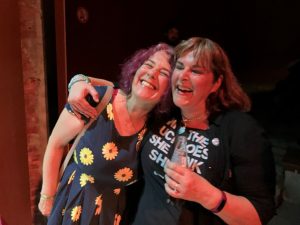
Lorna and Ruth from Hagar the Womb

Pussy Riot’s performance was not a conventional rock and roll set, more like radical rock theatre, with the band declaiming their poetry to throbbing music and a political back projection with surtitles in English. They told the story of their conflict with the Russian regime, the gig in the cathedral that got three of them arrested, the subsequent trail and the imprisonment of Maria (Masha) Alyokhina and Nadezhda Tolokonnikova. Masha had just escaped from Russia to avoid being imprisoned again for her opposition to the invasion of Ukraine; according to reports she had slipped out of her home disguised as a food courier.

It can’t have lasted for more than about an hour but it was intense, and emotionally hard-hitting; I thought that the music was excellent and the poetry remarkable. It was the kind of thing that makes me want to rush out of the venue and start the revolution. However at the end Masha looked sad; perhaps the time in prison had left its mark. The lyrics didn’t flinch from the emotional cost of life in a Russian penal colony, for all their defiance. Certainly it’s difficult to feel optimistic about political conditions in Russia at the moment, and the asinine decisions to boycott Russian culture can’t be helping either. The band finished by calling for donations to a children’s hospital in Ukraine.

Pussy Riot
Pussy Riot

Pussy Riot’s Riot Days tour continues. If you get a chance to see it, do go.

Update: Since this was written, Maria Alyokhina has been interviewed in The Guardian (London).

In The Air

A short review of the In The Air exhibition at the Wellcome Collection in London

I only had a few minutes to look around the In The Air exhibition at the Wellcome Collection in London, but I was impressed by how political it was. It was willing to look at air pollution in a political context; it included examples of the Hazards Bulletin published by the British Society for Social Responsibility in Science in the 1980s, and the BSSRS’ critical journal Science for People. There was even a pamphlet about the technology of political control that I remember owning. What blew me away however was the video produced by Forensic Architecture, that shows in detail how air pollution, produced by reckless and criminal despoiling of our forests and clean air, creates health threats across whole regions that transcend national borders. The shocking news about the murder of environmental activist Bruno Pereira and journalist Dom Phillips reminds us just how sharp and important the conflict around the earth’s resources is.

In The Air is on until the 16th October 2022.